


















The demand for mobile app development services has never been higher. In 2026, mobile devices account for well over 60% of all internet traffic globally. Consumers expect fast, intuitive, and personalized app experiences from every business they interact with, regardless of industry size. The gap between businesses that have invested in professional mobile app development and those that have not is growing wider every single month.
This blog breaks down exactly why professional mobile app development services are no longer optional for serious businesses, what the development process looks like, and what you need to look for when choosing the right team to build your app.
Key Takeaways
Everything you need to remember before taking your next step- Mobile app development services are a direct driver of revenue, retention, and competitive advantage in 2026, not just a technology purchase.
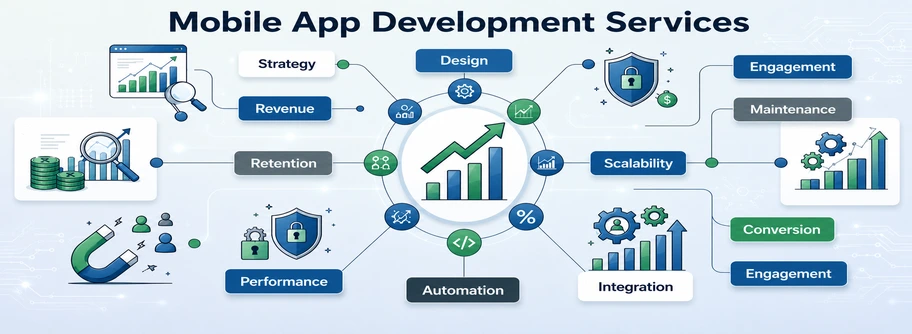
- Professional mobile app development covers far more than coding. It includes strategy, design, QA, launch, ASO, and ongoing maintenance.
- Choosing between native, cross-platform, and PWA approaches depends on your specific business goals. A professional team will guide you to the right fit.
- The application development process has six defined stages. Skipping any of them, especially QA and ASO, leads to costly failures after launch.
- Trending capabilities like AI integration, AR features, super app architecture, and hyper-personalization are now expected in competitive apps.
- Every major industry from healthcare to logistics is growing faster through professional mobile apps.
- When evaluating a mobile app development services partner, prioritize portfolio quality, full-cycle capability, IP ownership terms, and post-launch support.
- The ROI of a professionally built app compounds over time through higher engagement, repeat purchases, and reduced operational costs.
Why Mobile App Development Services Are a Business Growth Engine, Not Just a Tech Expense
A lot of business owners still think of mobile app development as a cost. It is not. It is a revenue channel, a customer retention tool, and a competitive advantage wrapped into one.Here is what a professionally built mobile app actually does for your business:
- Increases customer engagement through push notifications, personalization, and seamless UX
- Drives repeat purchases by making it easier to buy from you than from a competitor
- Builds brand loyalty through a consistent, branded experience in users' hands 24/7
- Collects first-party data that helps you make smarter marketing and product decisions
- Reduces operational costs by automating customer service, bookings, and transactions
- Opens new revenue streams through in-app purchases, subscriptions, and premium features
The Real Cost of Skipping Professional Mobile App Development
Choosing to skip professional mobile app development services or going with a cheap, template-based solution often costs more in the long run. Here is why:| DIY or Low-Quality App | Professional Mobile App Development |
| Generic UI with no brand identity | Custom design aligned to your brand |
| Poor performance and slow load times | Optimized for speed and smooth UX |
| Security vulnerabilities | Built-in security protocols and compliance |
| Limited scalability | Architecture built to grow with your business |
| Frequent bugs and crashes | Thorough QA testing before and after launch |
| No post-launch support | Ongoing maintenance and updates |
| Poor app store rankings | ASO-optimized for visibility and downloads |
A poorly built app does not just fail to help your business. It actively harms your reputation. Users who download a buggy, slow, or confusing app uninstall it within seconds and leave negative reviews that hurt your app store rankings for months.
Mobile App Development Services: Native vs Cross-Platform vs PWA in 2026
One of the first decisions in any mobile app development project is choosing the right technology approach. Each option has real advantages depending on your business goals, target audience, and budget range.Native Application Development
Native apps are built specifically for one platform, either iOS using Swift or Android using Kotlin. They deliver the best performance, the most access to device features, and the smoothest user experience.Best for: Businesses with high user engagement requirements, complex functionality, or performance-heavy features like AR, real-time tracking, or gaming.
Cross-Platform Mobile App Development
Frameworks like Flutter and React Native allow developers to write one codebase that runs on both iOS and Android. This reduces development time while still delivering near-native performance.Best for: Businesses wanting to launch on both platforms efficiently without doubling their development investment.
Progressive Web Apps (PWAs)
PWAs are web-based applications that behave like native apps. They are accessible through a browser, can work offline, and do not require app store downloads.Best for: Businesses looking for a lightweight, fast, and accessible mobile experience as a starting point.
| Type | Performance | Cost Efficiency | Platform Coverage | Best Use Case |
| Native | Excellent | Lower efficiency | Single platform | High-performance apps |
| Cross-Platform | Very Good | High efficiency | iOS + Android | Most business apps |
| PWA | Good | Highest efficiency | All devices | Content and e-commerce |
A professional mobile app development services provider will help you choose the right approach based on your specific goals, not just the one that is fastest or cheapest to build.
What the Professional Mobile App Development Process Actually Looks Like
Understanding the application development lifecycle helps you set realistic expectations and collaborate more effectively with your development team.Stage 1: Discovery and Strategy This is where your idea gets turned into a concrete plan. Business goals, target users, core features, technical requirements, and platform choices are all defined here. A professional team will also conduct competitor analysis and market research at this stage.
Stage 2: UX/UI Design Before a single line of code is written, designers create wireframes and interactive prototypes. This stage defines the user journey, visual identity, and interaction patterns. Good design at this stage prevents expensive redesigns later.
Stage 3: Mobile App Development The actual build phase. Front-end and back-end developers work simultaneously. APIs are integrated, databases are structured, and the core functionality takes shape. Agile development methodology is standard, with regular sprint reviews so you can track progress.
Stage 4: Quality Assurance and Testing Professional mobile app development services include rigorous QA. This covers functional testing, performance testing, security audits, device compatibility testing, and user acceptance testing (UAT). Apps that skip this stage are the ones that get one-star reviews.
Stage 5: App Store Launch and ASO Submitting to the Apple App Store and Google Play Store is not just uploading a file. It involves App Store Optimization (ASO), which includes keyword-optimized titles and descriptions, screenshot design, and category selection. This directly impacts how many people discover your app organically.
Stage 6: Post-Launch Maintenance and Updates The app does not end at launch. OS updates, new device releases, user feedback, and evolving business needs all require ongoing mobile app development work. A professional team stays with you after launch.
Key Mobile App Development Trends Driving Business Growth in 2026
The mobile app development services landscape has evolved dramatically. Here are the trends that are directly impacting what businesses are building right now:AI-Powered App Features From personalized recommendations to AI chatbots and predictive search, artificial intelligence is now a standard expectation in high-performing apps. Professional developers integrate AI APIs and machine learning models into application development workflows seamlessly.
Super App Architecture Inspired by all-in-one platforms, businesses are building apps that consolidate multiple services into a single experience. Instead of separate apps for booking, shopping, and support, users get everything in one place.
On-Demand App Development On-demand apps for delivery, services, healthcare, and logistics continue to see explosive growth. Real-time tracking, instant booking, and live communication features are driving this category.
Augmented Reality (AR) Integration AR is moving beyond novelty. Retail, real estate, education, and healthcare businesses are integrating AR into their apps to let users visualize products, spaces, and procedures before committing.
Wearable and IoT App Development With smartwatch adoption rising and IoT devices becoming mainstream, mobile app development services now frequently include companion apps for wearables and connected device management.
Hyper-Personalization Through Data Apps that use behavioral data to deliver personalized content, offers, and experiences are significantly outperforming generic alternatives in engagement and retention metrics.
.webp)
Industries That Are Winning with Professional Mobile App Development Services
No industry is immune to the mobile shift. Here is how different business categories are leveraging professional mobile app development:| Industry | Key App Features | Business Impact |
| Retail and E-commerce | Product browsing, AR try-on, one-tap checkout | Higher conversion rates |
| Healthcare | Appointment booking, telemedicine, health tracking | Improved patient retention |
| Food and Delivery | Real-time tracking, loyalty rewards, in-app payments | Increased order frequency |
| Real Estate | Virtual tours, property search, agent chat | Faster sales cycles |
| Education | Live classes, progress tracking, offline content | Better learner engagement |
| Logistics | Fleet tracking, delivery updates, driver management | Operational efficiency |
| Finance and FinTech | Secure payments, budgeting tools, investment dashboards | Higher user trust |
If your industry is on this list and you do not yet have a professional app, your competitors almost certainly do.
What to Look for When Choosing a Mobile App Development Services Partner
The agency or team you choose for mobile app development will make or break your project. Here is your non-negotiable evaluation checklist:- Portfolio with live apps: Ask for links to apps they have built that are live in the app stores. Check reviews and ratings.
- Full-cycle capability: The team should cover design, development, QA, and post-launch support, not just coding.
- Technology expertise: Ask specifically about their experience with Flutter, React Native, Swift, Kotlin, and cloud backends.
- Project management transparency: Regular updates, sprint reviews, and clear milestones are signs of a professional team.
- NDA and IP ownership: You should own 100% of the code, design, and data. Confirm this in the contract.
- App Store Optimization knowledge: Building a great app nobody finds is a wasted investment.
- Maintenance and support terms: What happens after launch? What is the response time for critical bugs?
- Client references: Speak directly to past clients about their experience, not just their results.
How Mobile App Development Services Deliver Measurable ROI
For decision-makers who need to justify the investment, here is how professional application development translates into measurable business returns:- Apps increase average order values compared to mobile web by a significant margin in most e-commerce categories
- Push notifications have dramatically higher open rates compared to email marketing
- Loyal app users spend more per transaction than non-app customers on average
- Apps reduce customer support costs by automating common queries through in-app help centers
- App-exclusive features drive subscription upgrades and premium tier adoption
Stop Losing Customers to Competitors with Better Mobile App Development Services
Your customers are already on their phones. The only question is whether they are spending time in your app or in a competitor's. Professional mobile app development services give you the infrastructure to compete, the user experience to convert, and the data to keep improving. In 2026, that is not a nice-to-have. It is the foundation every serious business needs to build on.Frequently Asked Questions
What are mobile app development services?
Mobile app development services cover the complete process of designing, building, testing, launching, and maintaining apps for iOS and Android platforms. This includes everything from UX design and backend development to App Store Optimization and post-launch support.
How long does professional mobile app development take?
A standard mobile app development project takes between 3 to 6 months depending on complexity, features, and platform requirements. Simple apps take less time while feature-rich or multi-platform applications take longer.
How much does mobile app development cost for a business?
Mobile app development costs vary based on complexity, platform choice, number of features, and the experience level of your development team. A basic cross-platform app costs significantly less than a feature-heavy native application with AI integrations or real-time functionality. The best approach is to request a detailed quote from a professional mobile app development services provider after sharing your project scope and business goals.
How do I know if my business needs a mobile app?
If your customers interact with your business more than once, if you offer bookings, purchases, or support, or if your competitors already have an app, you need mobile app development services. In 2026, a mobile app is a baseline expectation across almost every industry.
What features should a business mobile app include?
Every business app needs a clean onboarding flow, fast load times, secure login, push notifications, and an intuitive navigation structure. Depending on your industry, core features might also include in-app payments, real-time tracking, booking systems, or AI-powered personalization. Your mobile app development services team should prioritize features based on your users' actual needs, not just what looks impressive.